Download Mendeley
Engineering a Hetero-Bimetallic Azurin Photoenzyme for Photoredox Nitrite Reduction and SNO Adduct Formation.
Su, B., Yu, Y., Liu, H., Li, C.(2025) Chemistry 31: e202500143-e202500143
- PubMed: 40038049
- DOI: https://doi.org/10.1002/chem.202500143
- Primary Citation of Related Structures:
9L6D - PubMed Abstract:
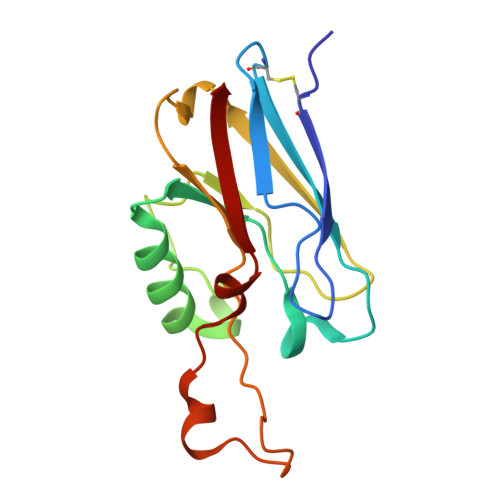
Photoredox catalysis in protein systems presents exciting opportunities to achieve sustainable and efficient enzymatic reactions driven by light. Here, we report the design and characterization of PhotoNiR, an engineered azurin-based protein incorporating a red copper center and a lanthanide-binding tag (LBT). This dual-metal system enables photoredox reduction of nitrite to nitric oxide via a proposed donor-f-electron-acceptor (D-f-A) electron transfer mechanism. Upon photoirradiation, aromatic residues in the LBT donate electrons to the lanthanide ion, which relays them to the Cu(II) center, reducing it to Cu(I). The reduced Cu(I)-PhotoNiR catalyzes the reduction of NO 2 - , and the generated NO subsequently reacts with free cysteine residues to form S-nitrosothiol (SNO) species. Spectroscopic and structural characterization confirmed that the copper center retains the properties of a red copper site and that the lanthanide-binding tag supports efficient electron transfer. This work represents one of the first examples of a D-f-A mechanism in a protein system, demonstrating the potential of integrating metalloprotein engineering with lanthanide photochemistry to develop novel photoenzymes for light-driven catalysis.
- Department: Institute of Biochemical Engineering, Key Laboratory of Medical Molecule Science and Pharmaceutics Engineering of Ministry of Industry and Information Technology, School of Chemistry and Chemical Engineering, Beijing Institute of Technology, Beijing, 102488, China.
Organizational Affiliation: