Download Mendeley
Ginsentide-like Coffeetides Isolated from Coffee Waste Are Cell-Penetrating and Metal-Binding Microproteins.
Tam, J.P., Huang, J., Loo, S., Li, Y., Kam, A.(2023) Molecules 28
- PubMed: 37764332
- DOI: https://doi.org/10.3390/molecules28186556
- Primary Citation of Related Structures:
6JI7 - PubMed Abstract:
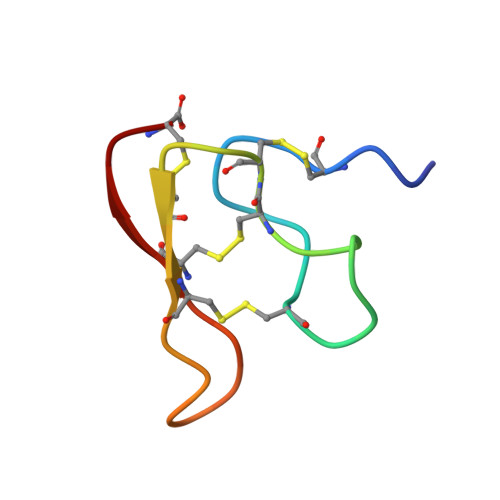
Coffee processing generates a huge amount of waste that contains many natural products. Here, we report the discovery of a panel of novel cell-penetrating and metal ion-binding microproteins designated coffeetide cC1a-c and cL1-6 from the husk of two popular coffee plants, Coffea canephora and Coffea liberica , respectively. Combining sequence determination and a database search, we show that the prototypic coffeetide cC1a is a 37-residue, eight-cysteine microprotein with a hevein-like cysteine motif, but without a chitin-binding domain. NMR determination of cC1a reveals a compact structure that confers its resistance to heat and proteolytic degradation. Disulfide mapping together with chemical synthesis reveals that cC1a has a ginsentide-like, and not a hevein-like, disulfide connectivity. In addition, transcriptomic analysis showed that the 98-residue micrcoproten-like coffeetide precursor contains a three-domain arrangement, like ginsentide precursors. Molecular modeling, together with experimental validation, revealed a Mg 2+ and Fe 3+ binding pocket at the N-terminus formed by three glutamic acids. Importantly, cC1a is amphipathic with a continuous stretch of 19 apolar amino acids, which enables its cell penetration to target intracellular proteins, despite being highly negatively charged. Our findings suggest that coffee by-products could provide a source of ginsentide-like bioactive peptides that have the potential to target intracellular proteins.
- Synthetic Enzymes and Natural Products Center, School of Biological Sciences, Nanyang Technological University, 60 Nanyang Drive, Singapore 637551, Singapore.
Organizational Affiliation: