Download Mendeley
How does Mycoplasma pneumoniae scavenge lipids from its host membranes?
Manger, S., Arghittu, S.M., Sprankel, L., Meier-Credo, J., Wieland, K., Bublak, D., Langer, J., Covino, R., Frangakis, A.S.(2025) Sci Adv 11: eady4746-eady4746
- PubMed: 41032592
- DOI: https://doi.org/10.1126/sciadv.ady4746
- Primary Citation of Related Structures:
9FCH - PubMed Abstract:
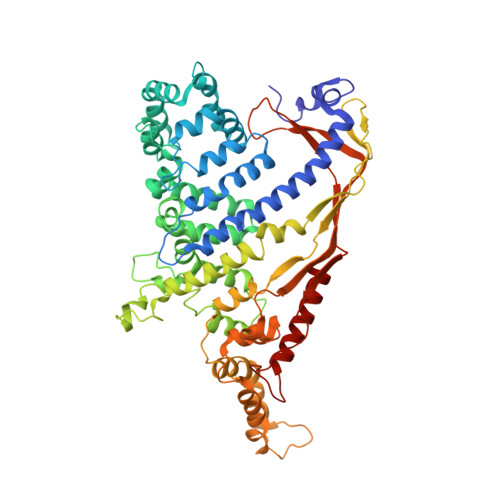
Lipid acquisition and transport are fundamental processes in all organisms. Here, we investigate the lipid uptake and delivery mechanism of the minimal model organism Mycoplasma pneumoniae . We show that the essential protein P116 can transport lipids between liposomes independently and without adenosine 5'-triphosphate consumption. Our structural data and molecular dynamics simulations reveal the mechanism by which the amino-terminal region of P116 perturbs the membrane, the lipid transfer route, and the regulation of membrane binding by the cargo mass within P116's large hydrophobic cavity. When adequately filled with cargo, P116 undergoes a rapid conformational change that modulates membrane binding. Together, our results show that Mycoplasma developed an integrated lipid uptake and delivery machinery that simplifies the complex multiprotein pathways used by higher developed organisms.
- Buchmann Institute for Molecular Life Sciences and Institute for Biophysics, Goethe University, Frankfurt am Main, Germany.
Organizational Affiliation: